
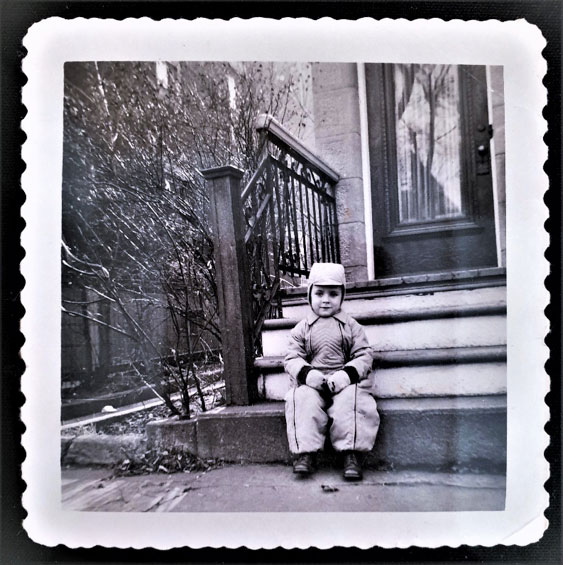
Let me tell you of the nature of happiness for a seven-year old. Uncomplicated and utterly inexpensive, it goes something like this:
Child leaves the table to go to the bay window, sticky-chinned and still chewing on the last piece of the two allotted slices of breakfast toast (jam and peanut butter).
Child looks out, transfixed: a cerulean sky and, on the ground, snow a shimmering constellation of blessedness, light and deep all at once, and bright enough to force a squint.
Child finds clothes in order to dress: yesterday’s garments are perfectly acceptable. Shirt buttons need not align, pants can be skewwhiff and socks unmatched – only thick. Shoes can stay under the bed, unwanted summer creatures that they are; but socks and over-socks, ski pants, jackets, mittens, a hat and a scarf and boots too, tight at the ankle to keep out the snow, are a must. (M’amie will stuff parka pockets with tissues for a snotty nose, so no need to be concerned on that account. However, a purloined jam biscuit or two will come in handy later).
Child listens to admonitions and nods: warnings about the danger of the perishing cold, the need to stay warm and to keep dry; about not sucking the metre-long roof icicles, nor going walking on the river ice to check that the ducks have gone (or listen out for the rushing water flow beneath, while stamping the surface to see how thick it has grown overnight); or, heaven forbid, go further out to the railroad to throw snowballs at the slow freight trains or stick your tongue on the track like the ruffian boys next door so wickedly suggested once.
Child goes to the barn to fetch the sled. It takes a while to traverse the five metres of drift separating the kitchen door from the barn door. Footprints are well worth studying along the way: it’s mark-making of a grand order. There may even be need for an angel or two. And then the heavy barn door takes some pushing open – enough anyway to drag out the short sled rather than the big one used when three of four want to race downhill together. Then the ladder must come out as well (trickier that, because it must be dragged without mishap or noise past the kitchen window to avoid detection).
Child ever so gently leans the ladder against the low side of the house roof. The other side of the house, the high side, is two stories high and well beyond reach. Common sense prevails, even at seven years of age. Ladder in place, it’s time to pull the short sled up onto the roof, one rung at a time.
Child carefully positions the sled on the roof apex at the far side of the house, facing the street. From the roof, there is a fall of two metres to the snowy slope below that, after a few metres, cliffs off onto the steep road, its surface hard-packed ice all the way down to the river, one hundred metres away: this is the speed strip, reached only if the sled is first guided safely and at speed through the gaps between the poplars that grow in a row at the edge of the property.
Child runs the length of the roof to throw himself full pelt onto the carefully positioned sled. Momentum is needed to fly off the roof edge and clear the eaves in a graceful, silent airy arc, all the way down to the explosion of swishing white powder that fills eyes, nose and mouth, flakes melting on the tongue or hanging on to eyelashes. This is the trickiest part of the happiness formula: the run must be quick, not only for reasons of physics associated with the launch, but for the child to be well out of earshot and a good way down the slope before M’amie, frightened out of her skin by the thumping of boots on the roof, comes tearing out of the kitchen to put an end to the joy so hardly fought for.

In the moment of flight, the child knows ecstasy, the thrill of the weightless fall and the soft thud that signals the return to earth (but a kind, embracing earth). He knows gathering speed and the brush of wind on his cheeks, the tug on the rope or the press of the boot to steer the sled left or right – the joy of the body that responds, leaning now this way and now that.
He knows too the different sounds that the snow makes under the sled: a cotton-wooled whoosh in the drift and the harsher, crackle of the sled wood when surfing the ice. Most striking of all, he knows the crystalline silence that rises when the sled comes to a halt at the end of the run, every centimetre of momentum used up and drained, as he sits still, transfixed, the only distractions the beat of his heart in his ears, the cracking of frozen branches above and the swish of his moving limbs when they rub against his parka.
He knows that snow has a taste. That icicles have a taste. That sucked mittens have a wooly or leathery taste. That frozen snot has a taste, as do the broken jam biscuits dragged out of deep pockets, eaten among the brittle-frozen shore reeds while looking for ducks and tracing cracks in the filigree ice to see the water rise through them and form patterns around snow boots, while air bubbles lazily pop to the surface. And then there is the turning for home, and once there, pumpkin and turnip soup with bread and butter, and warmth and the sleepiness that blurs the child’s eyes roaming over a picture book and closes them, and the noise of M’amie in the kitchen and in the nostrils still, trapped in some deep follicle but released now, the smell of the frozen river and the world below the ice.


August 2020