
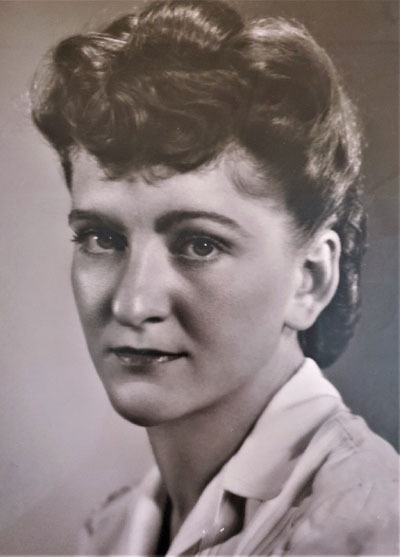
I strive to imagine them, these hands of my mother’s. I look to her portrait for help. I recently took it out of storage and its protective layers of wrapping. I wanted to show my son his grandmother, whom he was asking about. Our conversation had turned to times and places where winter was truly winter, spring an explosion missed from one week to the next, summer a boundless string of bike riding, popsicles and beach days before the wheel would turn back to autumn and a final, effulgent spray of colour. That is where my mother belonged. And where I belonged too. For a time.
Jacqueline, my mother, stares out, wistful-eyed, head tilted slightly downward, with the merest trace of a smile on her lips. And always, at this point, my perennial question: Is that faint smile what I wish to see rather than what is? Her gaze is shy – not timid, for I know her to have ridden powerful horses fearlessly, much to my less-assured father’s anguish and damaged pride. I suspect that she agreed to the portrait-taking to please someone, likely Jean-Jules, as they were courting at the time. Of course, the portrait tells me nothing of her hands.
Often enough, at nightfall, on turning off the light after checking the set of the alarm, I return to the task of imagining her – imagining her when, in fact, I should be remembering her: the fragrance of her skin in the crook of her neck, a murmuring voice, the fall of hair, chestnut dark; a way of walking, the rougher wool fabric of a winter skirt, a bare leg in summer or bed, a breast to suckle and, of course, hands: hands to hold, lift, console, caress, ease, defend, scold; hands offered in play, finger by finger, for me to grasp; hands to button up my jumpsuit or strip me bare to lower me into a bath, straighten a blanket, stroke me goodnight; hands with which to feed me, help me cross the street and hold a pencil to have me form my first letters.
But of course, I cannot remember: eyes tightly shut or wide open into a darkness broken only by the faintest of light that traces the room’s closed blinds, this remembering produces naught but a void that cannot be populated. Imaginings thrown into it find no purchase, neither hook nor fault of face for them to latch onto, no accidents of surface upon which life can cling and memories take root and rise, defying gravity and the great abyss in which absence dwells.
My mother clung to her last days, I’m told, fought to cling, I’m assured. But in the real world, which is not that of my imaginings, she fell: neither the birth-bed nor the hospital one into which she died could hold her for the sum of my first seven days. How then, by what consoling magic, could I imagine my mother’s hands?


October 2020